
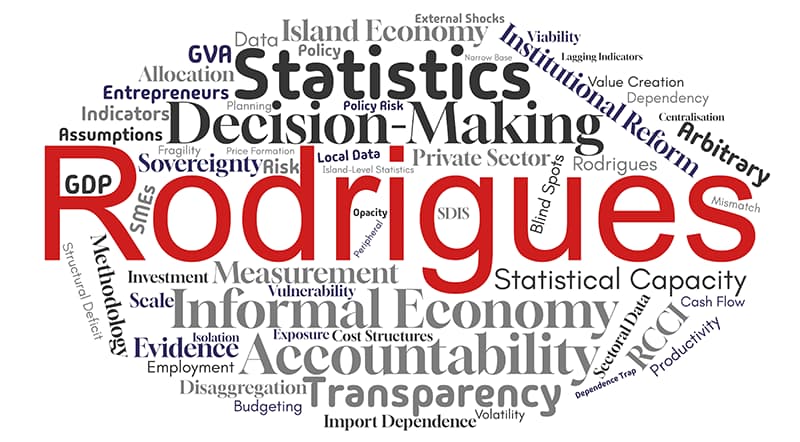
Rodrigues cannot manage what it cannot measure. While the Rodrigues Regional Assembly Act 2001 explicitly assigns responsibility for the production of statistics relating to Rodrigues to the Regional Assembly, the island remains without the most basic macroeconomic indicators. The absence of a Consumer Price Index (CPI) for Rodrigues, the lack of income and purchasing-power statistics, and — most critically — the absence of a Gross Domestic Product (GDP) for the island create a vacuum that undermines evidence-based policymaking, private-sector planning, and transparent governance.
The current data blackout amounts to an institutionalised retention of information. It obscures economic realities, prevents accountability, and makes it impossible for Rodrigues to understand its own performance, vulnerabilities, and prospects. This situation is untenable for an autonomous island region that must navigate structural dependency, climate vulnerability, and a rapidly changing economic environment.
A comprehensive system of island-level statistics is urgently required. The RCCI proposes a set of corrective actions to restore transparency, empower economic actors, and enable sound planning.
Introduction: A Strategic Imperative
As Rodrigues enters 2026, the Rodrigues Chamber of Commerce and Industry (RCCI) is setting a series of strategic priorities to catalyse the island’s private-sector and institutional development. Among these, one mission stands out for its long-term importance and transformative potential: the pursuit of statistical sovereignty.
By this, the RCCI means the capacity of Rodrigues to generate, access, and use its own robust, island-specific economic and social statistics — data that are essential for informed decision-making, transparent governance, and sustainable private-sector growth.
“Without reliable data, informed decisions and
confident long-term planning are impossible.”
Statistics: The Foundation of a Modern Economy
Reliable statistics form the backbone of any modern economy. They allow policymakers to evaluate economic trends, assess sectoral performance, allocate resources efficiently, and calibrate interventions for maximum impact. For the private sector, such data underpin investment decisions, market analysis, and business planning. Citizens, too, benefit from transparent access to information that allows them to understand government policies and hold institutions accountable. In short, data are not merely numbers; they are the language through which an economy understands itself. Without this language, Rodrigues risks navigating its future blindfolded.
Despite the existence of a statutory statistical office and the technical capacities of Statistics Mauritius, Rodrigues currently faces significant gaps in island-specific data. The absence of key indicators — such as a Consumer Price Index tailored to Rodrigues, comprehensive labour-market data, sectoral output values, and most critically, an island-level Gross Domestic Product or Gross Value Added — limits the ability of local actors to make informed decisions. Aggregated national statistics, while useful at the Republic level, often obscure the unique economic realities of Rodrigues. Differences in transportation costs, market structures, agricultural productivity, and the impact of tourism and environmental factors cannot be fully captured in broad national averages.
From Structural Constraint to Strategic Opportunity
These gaps are not the result of negligence or incapacity. On the contrary, Statistics Mauritius routinely collects raw data relating to Rodrigues across numerous domains, from prices and employment to agriculture, trade, transport, and tourism. The institution possesses the technical expertise to generate island-specific series. However, methodological, administrative, and resource constraints have historically limited the production and publication of Rodrigues-specific statistics. The result is a situation in which local economic trends and sectoral realities are only partially visible, and the island’s full potential to plan, invest, and grow remains constrained.
For the RCCI, this situation presents both a challenge and an opportunity. The mission of statistical sovereignty is not a critique of existing institutions but a call for constructive collaboration. It envisions a framework in which Rodrigues develops its capacity to generate, interpret, and use data, in partnership with Statistics Mauritius and other relevant stakeholders. Such a framework would ensure that statistics reflect the island’s unique conditions, supporting informed decision-making while remaining aligned with national standards and international best practices.
“Statistical sovereignty turns data
into a powerful tool for guiding decisions
and shaping Rodrigues’ future.”
The Central Role of GDP and Sectoral Indicators
At the core of this mission is the need to develop an island-level GDP. A Rodrigues GDP would serve as the fundamental benchmark for measuring economic performance, evaluating sectoral growth, and informing policy decisions. It would allow the island to track its evolution in areas such as tourism, agriculture, fisheries, and emerging sectors like aquaculture and food processing. By providing a clear measure of growth, productivity, and diversification, an island GDP would empower policymakers, the private sector, and civil society to make decisions based on evidence rather than assumption. It would also serve as a tool for fiscal oversight, allowing the effectiveness of public investments and transfers from Mauritius to be assessed with clarity and precision.
Alongside GDP, other key indicators are vital. A Rodrigues-specific Consumer Price Index would reveal local inflationary trends, particularly during exogenous shocks such as the anticipated surge in tourism following the opening of the New Airport, or supply chain disruptions that national averages would miss. Labour-market data, including unemployment, underemployment, wages and productivity, would allow workforce planning and skills development programmes to be targeted where they are most needed. Agricultural and fisheries statistics that include both volume and value would provide a true picture of sectoral performance, helping to ensure that subsidies, development support, and investment are efficiently allocated. Collectively, these indicators would provide a comprehensive view of the island economy, enabling both public and private actors to respond proactively to changing circumstances.
Three Pillars for Building Statistical Sovereignty
The RCCI’s vision of statistical sovereignty is structured around three complementary pillars. The first is institutional strengthening and local capacity-building. This involves clarifying the mandate and role of the Rodrigues statistical office, gradually expanding its outputs, and establishing a core team of trained professionals within the island. Investment in human capital is crucial; a small, skilled team can effectively manage data collection, survey design, compilation, and analysis, building a culture of high-quality statistics from the ground up.
The second pillar is technical collaboration with Statistics Mauritius. This partnership leverages the expertise, methodologies, and resources of the national statistical office to support Rodrigues in producing high-quality, internationally comparable statistics. Cooperation may include sharing raw data, co-designing surveys, providing technical assistance in national accounts compilation, and jointly developing the methodology for Rodrigues GDP. Far from duplicating national efforts, this collaboration ensures that Rodrigues benefits from methodological rigor while tailoring outputs to the island’s specific needs.
The third pillar focuses on transparency, accessibility, and public engagement. Data are most powerful when they are available to those who need them. The RCCI envisions an annual Rodrigues Economic Overview, produced collaboratively with the local statistical office, summarising GDP, inflation, employment, sector trends, and policy-relevant insights. Open access datasets, with appropriate privacy safeguards, would allow independent analysis, support academic research, and enable informed decision-making by businesses and civil society. A multi-stakeholder advisory committee — including government representatives, industry associations, agricultural and tourism bodies, NGOs, and academia — would guide the relevance, balance, and dissemination of statistics. Such engagement strengthens trust, accountability, and the practical usefulness of data.
Why Action Is Needed Now — Starting in 2026
Why is this mission a priority for 2026? Rodrigues is undergoing rapid structural change. The tourism economy is growing, input costs are rising, climate vulnerability is increasing, and emerging sectors such as agro-processing and aquaculture are beginning to reshape the local economic landscape. Demographic shifts, evolving labour markets, and new business models add further complexity. Without reliable, island-specific statistics, decision-makers risk operating in uncertainty, investments may be misdirected, and development support cannot be effectively calibrated. Statistical sovereignty addresses this challenge head-on, providing the foundation for strategic planning, evidence-based policy, and sustainable economic growth.
Implementing statistical sovereignty is not merely a technical task; it is a mission that embodies the RCCI’s commitment to the island’s long-term development. It requires collaboration across institutions, engagement with local stakeholders, and investment in capacity and methodology. It also requires a cultural shift: statistics should be seen not as a bureaucratic obligation, but as a tool for empowerment, transparency and accountability. When Rodrigues can measure itself accurately, it can act confidently, anticipate challenges, seize opportunities, and advocate effectively in national and international forums.
Concrete Objectives for the Year Ahead
By prioritising this mission in 2026, the RCCI seeks to set the stage for a transformative decade. Statistical sovereignty will provide the island with the tools to track its economic evolution, assess policy interventions, and support the private sector in planning and investment. It will create a credible, transparent, and participatory statistical ecosystem that empowers decision-makers, businesses, and citizens alike. The RCCI envisages a Rodrigues in which data are not merely collected, but actively used to drive sustainable development, foster accountability, and strengthen institutional autonomy.
In practical terms, 2026 will focus on several key actions: defining a roadmap for developing island-specific GDP and other critical indicators; building the capacity of the local statistical office; formalising collaboration with Statistics Mauritius, and initiating stakeholder engagement mechanisms; and producing the first comprehensive annual economic overview for Rodrigues. Each of these steps contributes to the larger objective of embedding a culture of evidence-based decision-making and ensuring that Rodrigues’ economic realities are visible, measurable and understood.
The RCCI invites all partners — government agencies, Statistics Mauritius, local authorities, private-sector actors, and civil society — to join in this mission. Statistical sovereignty is, by its nature, a collaborative endeavor. Its success depends on shared commitment, dialogue, and a focus on practical outcomes. Together, stakeholders can create a framework in which Rodrigues is no longer constrained by gaps in data but empowered by accurate, timely, and relevant statistics that illuminate the island’s economic and social landscape.
“By the close of 2026, Rodrigues will be firmly
on the road to measuring itself
accurately — and act with confidence — as
statistical sovereignty takes shape.”
Conclusion: A Commitment to the Future
Ultimately, the mission of statistical sovereignty is about enabling Rodrigues to navigate its future with clarity, confidence, and resilience. It is about giving the island the tools to understand its economy, support its entrepreneurs, plan effectively, and ensure that public resources are used wisely. By making this a priority in 2026, the RCCI reaffirms its commitment to a Rodrigues that is informed, capable, and prepared to shape its own destiny.
In a world where data drives decisions, statistical sovereignty is not a luxury — it is a necessity. The RCCI’s 2026 mission is therefore both timely and essential: to build a robust statistical foundation for Rodrigues, one that supports evidence-based governance, sustainable economic development, and shared prosperity for all.

